
At Trendio, we have historically been skeptical of broad calls to invest in “full funnel marketing.”
Part of that skepticism came from the traditional challenges of awareness marketing itself: difficult attribution, unclear ROI, and a tendency for marketers to justify almost any outcome after the fact. But more importantly, we felt that much of the underlying thinking had not fully adapted to the realities of digital and social commerce.
Over the past decade, marketing thinking evolved from the classic linear funnel to more sophisticated “customer journey” frameworks. But while the diagrams became more complex, the underlying assumption often remained the same: discovery and purchase happened in separate environments and therefore required separate marketing layers.
That assumption is increasingly outdated.
On platforms like TikTok Shop, discovery, consideration, and purchase increasingly happen in the same feed, often through the same piece of content. The distinction between “awareness content” and “conversion content” has become blurrier. The same affiliate video can simultaneously introduce a user to a brand, create social proof, and drive a purchase.
This is part of the reason we have also been skeptical when platforms encourage brands to invest “higher up the funnel” in order to improve GMV Max performance.
The logic often sounds circular. Invest more in awareness, GMV Max ROI improves, therefore awareness works. Hopefully. If a brand invests another $100K in advertising, one would certainly expect it to have some impact on performance. The more important question is whether the combined economics improve sufficiently to justify the incremental investment.
And for many emerging brands, traditional awareness approaches are simply not realistic. Broad-reach media is either unaffordable or too diluted to create meaningful impact.
But over the past few months, we have started testing a full-funnel approach that deviates from traditional awareness marketing. Instead of maximizing broad reach, the objective is to create concentrated familiarity within a subset of users in order to improve conversion efficiency.
We refer to it internally as user conditioning.
The Cold Start Problem on TikTok Shop
One of the realities we consistently observe on TikTok Shop is that large, established brands often achieve substantially stronger GMV Max ROI than smaller or emerging brands. This is true even when the creative quality is similar, the offers are comparable, and the affiliate strategy is reasonably well executed.
Historically, we attributed this primarily to abstract brand equity. But we increasingly believe something more mechanical is happening.
Large brands arrive on TikTok Shop with users who are already conditioned. Users recognize the brand, have seen it repeatedly before, and therefore engage differently the first time GMV Max serves them a conversion-oriented ad.
Smaller brands, by contrast, face a cold-start problem.
GMV Max is extremely effective at identifying and scaling users who are already showing buying intent. But for low-awareness brands, many users ignore the first exposure entirely. Click-through rates are lower, conversion rates are lower, early signals are sparse, and GMV Max remains stuck in broader exploration mode.
Conditioning Instead of Traditional Awareness
The approach we started testing attempts to solve this problem directly.
Instead of broad awareness campaigns, we run targeted reach and frequency campaigns designed to repeatedly expose category-relevant users to a brand over a short period of time before activating GMV Max. The objective is not mass awareness. It is to create familiarity when it’s lacking, more predictably and often at a lower cost than relying on GMV Max itself to generate repeated exposure through costly conversion-oriented delivery.
The underlying hypothesis is relatively simple. Repeated exposure conditions a subset of users to the brand. GMV Max, during its normal exploration process, eventually lands on some of these users. Because these users are already familiar with the brand, they display stronger engagement and purchase signals. This allows GMV Max to increasingly concentrate delivery around similar users and behaviors, improving overall conversion efficiency.
Over time, the system may not simply identify conditioned users, but increasingly learn the types of users for whom repeated exposure is most effective, allowing the platform to algorithmically reproduce aspects of the conditioning process itself.
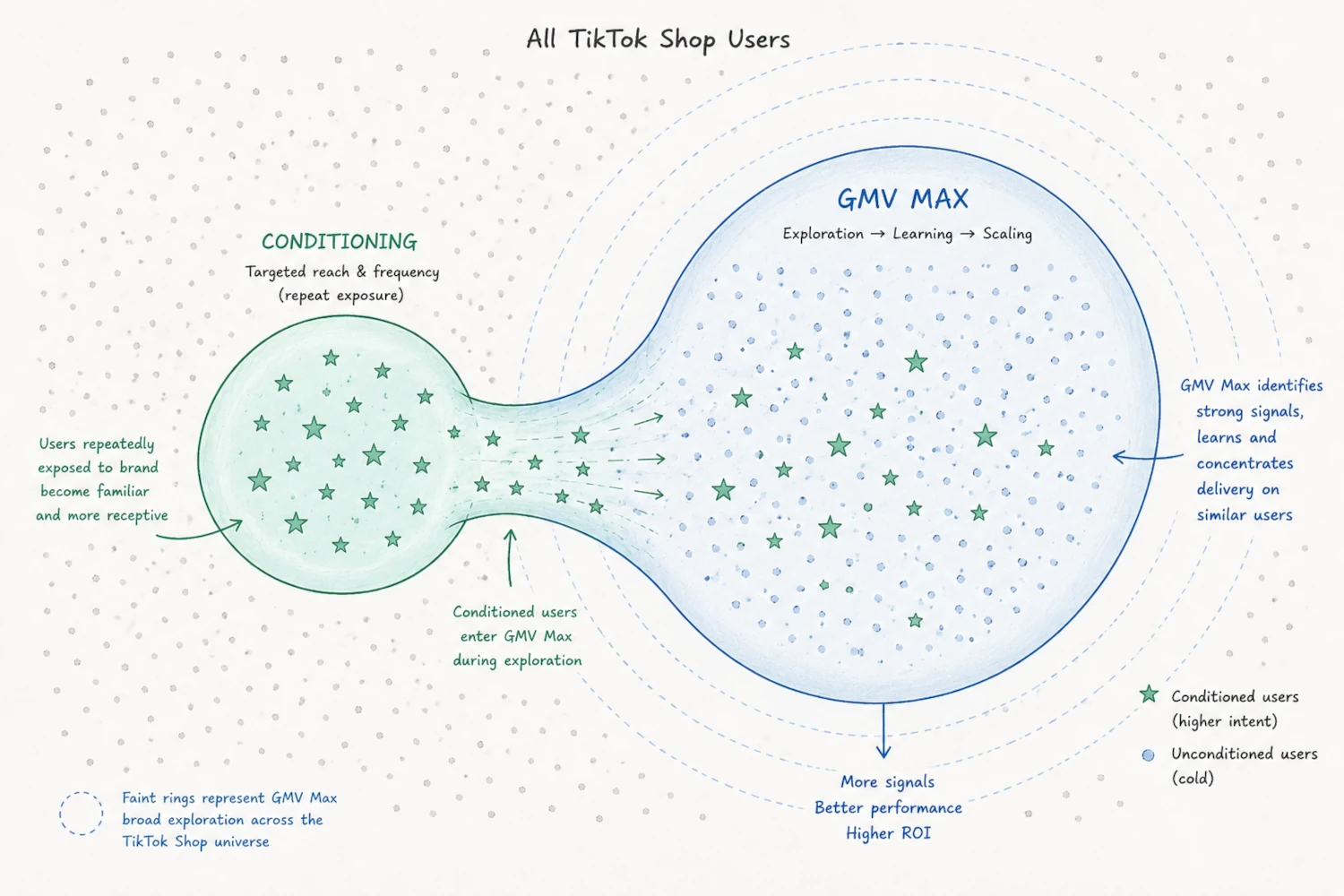
This changes the nature of awareness. The objective is not to make the brand broadly known across the platform ¬— an unrealistic goal for many smaller brands. It is to create the perception of ubiquity within a concentrated subset of users. When users repeatedly encounter different affiliates discussing the same product, they experience the brand as culturally present and socially validated, regardless of how many users are actually seeing the campaign. In that sense, conditioning transforms awareness from a mass-media exercise into a targeted and algorithmically discoverable signal-generation process, accessible to brands of all sizes.
It also does not require awareness and conversion to happen through separate media ecosystems. In many cases, the exact same affiliate content can be used across both stages. The difference is sequencing and delivery logic.
Why Affiliates Matter Differently Under This Model
This framework also changes how we think about affiliate roles.
Traditionally, affiliate programs tend to optimize almost exclusively around direct GMV generation. But under a conditioning framework, creators can serve different functions.
Some affiliates are highly effective at driving conversion. Others are effective at driving broad category reach and repeated exposure.
The latter group may not generate strong direct sales on their own, but they may still create substantial value by conditioning future buyers more efficiently than branded advertising alone. This is particularly interesting because affiliate content often feels more native, varied, and socially credible than traditional brand creative.
Early Results
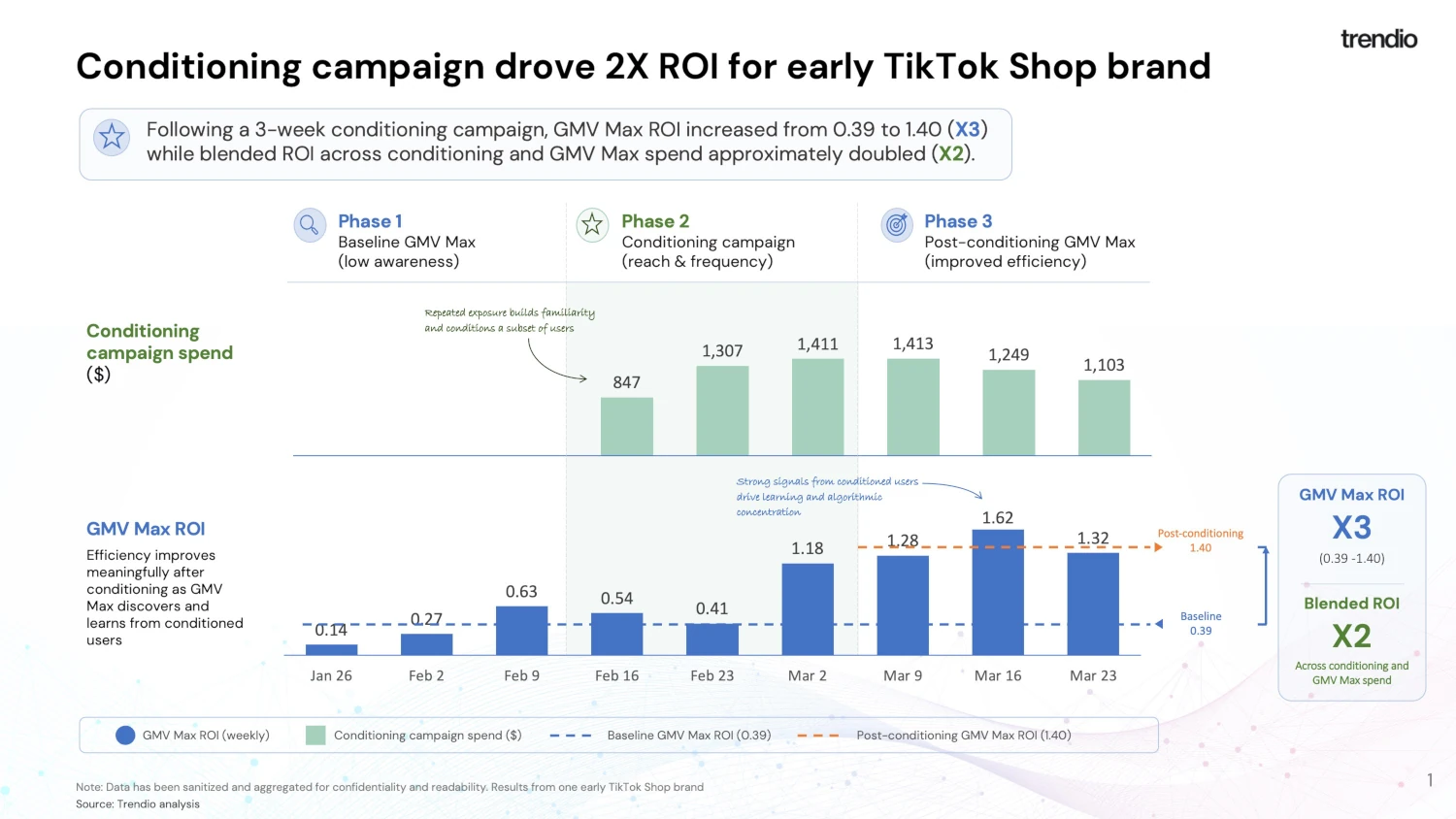
We have now tested this framework in a small number of cases. While still early, the initial results have been encouraging.
In two separate implementations, GMV Max ROI increased materially after introducing a conditioning phase, and blended ROI across conditioning and GMV Max spend roughly doubled.
These are still small-scale tests, and we do not yet view the framework as fully proven. There are important open questions around optimal audience sizing, the use of lookalike audiences, frequency levels, decay over time, maintenance spend, and how broadly this applies across categories.
But the early directional evidence is compelling enough that we believe the approach deserves serious exploration.
Rethinking Full Funnel Marketing
Beyond the mechanics, we believe this approach fundamentally reinvents full-funnel marketing, reflecting how digital and social commerce have changed the operational logic of the funnel itself.
In traditional media environments, awareness depended on broad distribution. Brands attempted to reach as many people as possible, hoping exposure would eventually translate into purchase intent.
On algorithmic commerce platforms like TikTok Shop, awareness no longer needs to be broad to be economically powerful. It can be concentrated, probabilistic, and intentionally engineered within small but algorithmically discoverable audiences.
Under this framework, the role of awareness is not to maximize exposure. It is to accelerate signal formation, condition likely buyers, and improve downstream conversion efficiency.
The funnel may survive, but its operational logic increasingly belongs to the algorithm.
About Trendio
Trendio is a video shopping technology provider and agency that works with brands across categories on TikTok Shop, YouTube Shopping and video web embedding. Trendio combines proprietary AI solutions with channel expertise to identify and engage the best affiliate creators for every brand in every channel, manage their entire video creation process, optimize brands' own video posts using video AI, manage paid ads for maximum returns and deliver best-in-class tracking. For more information, visit www.trendio.ai.
About the Author(s)
Alex Perez-Tenessa is the Founder & CEO of Trendio. Prior to Trendio, he was the VP of US Prime Video at Amazon, VP of Beauty and Personal Care at CVS Health and Partner in the Retail Practice of McKinsey & Company.